

Introduction
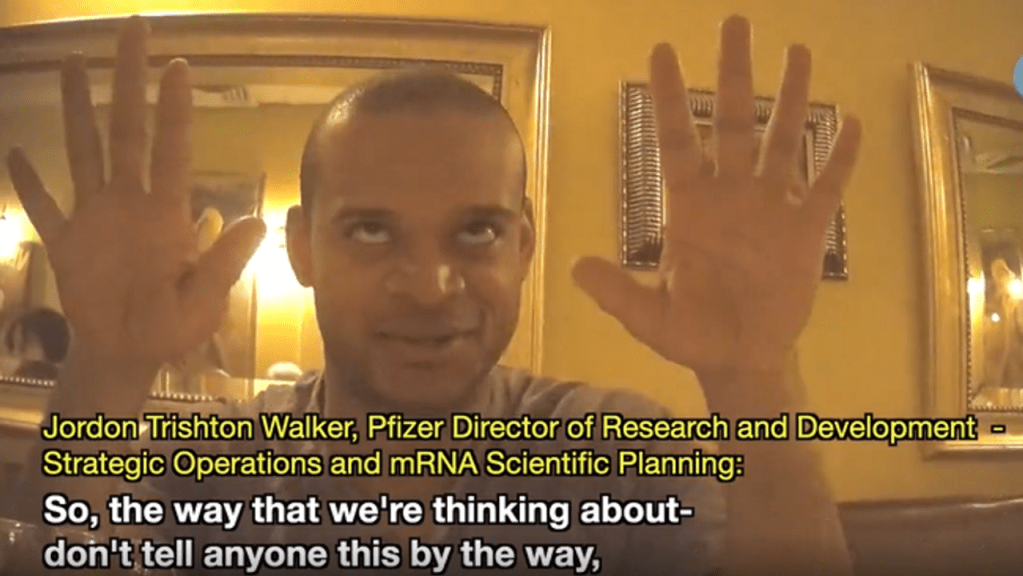
In early 2023, investigative journalism group Project Veritas released covertly recorded footage of Dr. Jordon Trishton Walker, a Pfizer executive, allegedly discussing the company’s controversial COVID-19 research. The videos sparked widespread debate over gain-of-function research, regulatory oversight, and the pharmaceutical industry’s transparency. This article examines the claims made in the footage, Pfizer’s response, and the broader implications for public health and policy.
Project Veritas’ Hidden Camera Footage
Project Veritas released two videos (January 25, 2023, and February 2, 2023) featuring what they claim is Pfizer’s Director of Research and Development – Strategic Operations and mRNA Scientific Planning, Dr. Jordon Walker. In the recordings, Walker makes several striking statements:
- Directed Evolution: “We do these selected structure mutations to try and see if we can make them more potent.”
- Virus Mutation for Preemptive Vaccine Development: “Why don’t we just mutate it ourselves so we could pre-emptively develop new vaccines?”
- Concerns About Hormonal Impact on Women: “Because it has to be affecting something hormonal to impact menstrual cycles. That is a little concerning.”
- Regulatory Capture: “All the government officials who review our drugs eventually come work for pharma companies. They’re not going to be as harsh on the company.”
The hidden camera footage led to immediate controversy, with proponents arguing it confirmed long-standing suspicions about the pharmaceutical industry’s motives, while critics dismissed the video as misleadingly edited and lacking context.
Pfizer’s Response
Pfizer issued a public statement denying the allegations, specifically addressing claims of gain-of-function research. The company stated:
“Pfizer has not conducted gain-of-function or directed evolution research. In a limited number of cases, when a full virus does not contain any known mutations, we conduct research to assess neutralization of new variants by existing vaccines.”
They emphasized that their research follows public health guidelines and is published in peer-reviewed journals.
Gain-of-Function Research Concerns
The concept of gain-of-function (GoF) research—where pathogens are modified to study their transmissibility or virulence—has been a topic of intense debate. Critics argue it poses extreme biosafety risks, as seen in past controversies, including research conducted at the University of Wisconsin-Madison that modified avian influenza to make it transmissible in mammals (Herfst et al., 2012, Science).
In this case, if Pfizer were engaging in GoF research, it could violate regulations on pathogen modification. However, mainstream experts, such as Dr. Paul Offit of the FDA’s Vaccines and Related Biological Products Advisory Committee, argue that Pfizer’s vaccine research does not meet the definition of GoF because it does not involve modifying an entire virus.
Regulatory Capture and the Revolving Door Problem
Dr. Walker’s claim that regulators later work for pharmaceutical companies is well-documented in scientific and policy literature. A 2018 study published in JAMA (Cohen et al., 2018) found that nearly 60% of FDA regulators who reviewed drug approvals later took jobs in the pharmaceutical industry. This raises ethical concerns about regulatory impartiality, as it suggests a potential conflict of interest where regulators may be lenient on drug approvals to secure future employment.
Health Concerns: Menstrual Cycle Disruptions
Walker’s mention of the vaccine’s potential hormonal impact aligns with growing concerns about menstrual cycle irregularities post-vaccination. A study published in NIH/National Library of Medicine (Male, 2021) observed reports of temporary cycle disruptions in women receiving mRNA COVID-19 vaccines. While these changes were mostly short-term, the lack of initial research into such side effects highlights a broader issue: inadequate long-term studies on novel pharmaceutical interventions.
Policy and Public Trust
The revelations from Project Veritas, whether entirely accurate or not, reinforce public distrust in pharmaceutical corporations and regulatory agencies. Given Pfizer’s billion-dollar contracts with governments worldwide, transparency is crucial to maintaining public confidence in vaccine safety.
Conclusion
The hidden camera footage of Dr. Jordon Walker adds another chapter to the ongoing scrutiny of Big Pharma’s practices. While Pfizer denies gain-of-function research, concerns about regulatory capture and potential health risks persist. The lack of definitive answers underscores the need for greater transparency in medical research and corporate-government relations.
References
- Herfst, S., et al. (2012). Science, “Airborne Transmission of Influenza A/H5N1 Virus Between Ferrets.”
- Cohen, D., et al. (2018). JAMA, “The FDA-Pharma Revolving Door and Its Impact on Drug Regulation.”
- Male, V. (2021). NIH/NLM, “Menstrual Changes Following COVID-19 Vaccination.”
- Pfizer Statement: Pfizer Official Website
- Project Veritas Video: Twitter Link
 The Conspiracy Library
Leave a comment